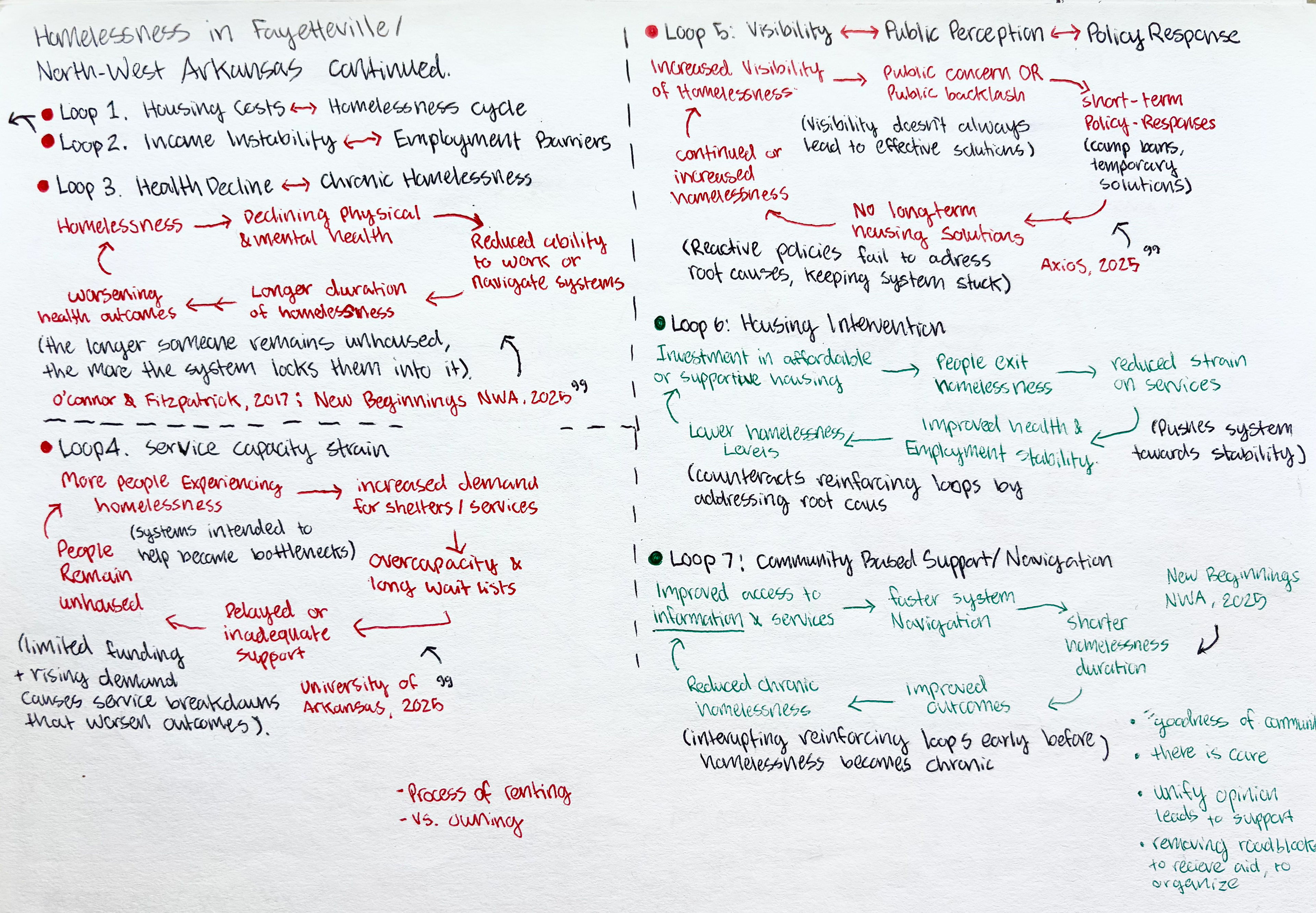
The focus of this project is to create and design a complexity map that eloquently represents an issue local to Fayetteville, Arkansas. The problem I target is the rising homeless population, including all of its contributing factors and feedback loops. This first diagram showcases my initial exploration of the topic and its interconnected parts. As I begin to recognize patterns, I start organizing them into cause-and-effect loops, or feedback loops.

To further organize the connections I made, I separated each loop into different categories, covering housing costs, income instability, employment barriers, health, visibility, and public perception. Once I had a better understanding of the pain points, I constructed potential negative feedback loops to counteract the positive feedback loops. My complexity map began taking shape.
After organizing the feedback loops, I went back to clearly define the parts of the system that perpetuate homelessness, the people affected, what is confusing about the subject, what matters most, and who my audience is and what my goal is for the viewer. With a clearer picture of the scale of this issue, I continued to construct potential complexity map layouts that would best communicate how this system functions.


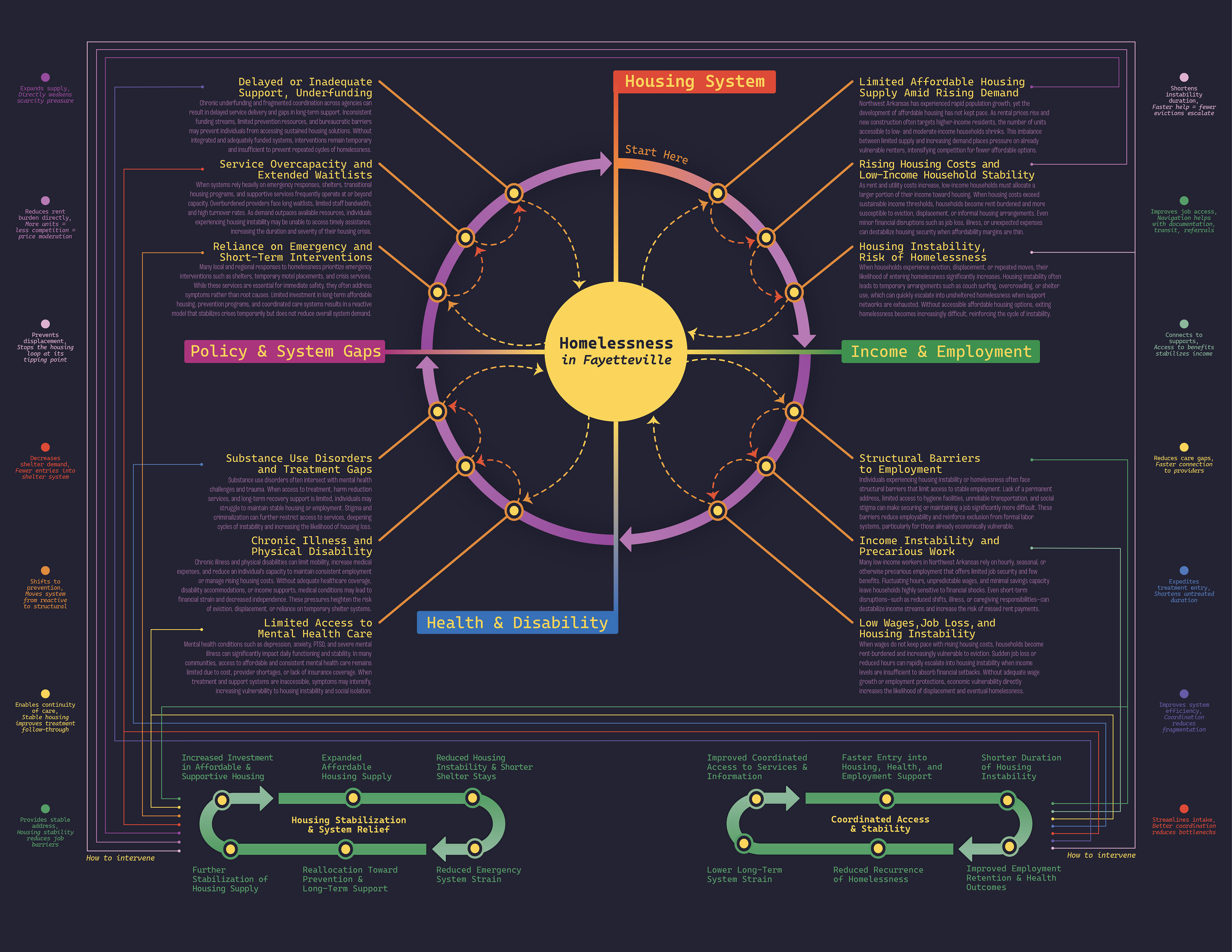
The layout I landed on is a hybrid between a radial map and a network map, creating a two-tiered system. The outer loop shows four major topics that each lead into the next: the housing system, income and employment, health and disability, and policy/system gaps. Within each quadrant is another feedback loop for its respective topic, showing the multifaceted machine that drives homelessness in Fayetteville.

My finished complexity map expands on the previous layout, clearly defining each section and illustrating how each step connects to the next. Beneath the central positive feedback loop are two negative feedback loops, each exploring potential solutions that could begin to reverse homelessness. Because homelessness is a complex system, there is no single solution that can address the issue on its own. Instead, each negative feedback loop identifies specific points within the main system where interventions could help break the cycle. I believe this is one of the clearest visuals for not only understanding homelessness in Fayetteville, but in general.